|
| | getDirectMessages ($sinceId=0, $maxId=0, $count=20, $entities=null, $skipStatus=null) |
| |
| | getSentDirectMessages ($sinceId=0, $maxId=0, $count=20, $page=0, $entities=null) |
| |
| | sendDirectMessages ($user, $text) |
| |
| | getDirectMessagesById ($id) |
| |
| | deleteDirectMessages ($id, $entities=null) |
| |
Twitter API Direct Messages class for the Joomla Platform.
- Depuis
- 3.1.4
- Obsolète:
- 4.0 Use the
joomla/twitter package via Composer instead
◆ deleteDirectMessages()
| deleteDirectMessages |
( |
|
$id, |
|
|
|
$entities = null |
|
) |
| |
Method to delete the direct message specified in the required ID parameter.
- Paramètres
-
| integer | $id | The ID of the direct message. |
| boolean | $entities | When set to true, each tweet will include a node called "entities,". This node offers a variety of metadata about the tweet in a discreet structure, including: user_mentions, urls, and hashtags. |
- Renvoie
- array The decoded JSON response
- Depuis
- 3.1.4
Références $data, $id, et $path.
◆ getDirectMessages()
| getDirectMessages |
( |
|
$sinceId = 0, |
|
|
|
$maxId = 0, |
|
|
|
$count = 20, |
|
|
|
$entities = null, |
|
|
|
$skipStatus = null |
|
) |
| |
Method to get the most recent direct messages sent to the authenticating user.
- Paramètres
-
| integer | $sinceId | Returns results with an ID greater than (that is, more recent than) the specified ID. |
| integer | $maxId | Returns results with an ID less than (that is, older than) or equal to the specified ID. |
| integer | $count | Specifies the number of direct messages to try and retrieve, up to a maximum of 200. |
| boolean | $entities | When set to true, each tweet will include a node called "entities,". This node offers a variety of metadata about the tweet in a discreet structure, including: user_mentions, urls, and hashtags. |
| boolean | $skipStatus | When set to either true, t or 1 statuses will not be included in the returned user objects. |
- Renvoie
- array The decoded JSON response
- Depuis
- 3.1.4
Références $count, $data, et $path.
◆ getDirectMessagesById()
| getDirectMessagesById |
( |
|
$id | ) |
|
Method to get a single direct message, specified by an id parameter.
- Paramètres
-
| integer | $id | The ID of the direct message. |
- Renvoie
- array The decoded JSON response
- Depuis
- 3.1.4
Références $data, $id, et $path.
◆ getSentDirectMessages()
| getSentDirectMessages |
( |
|
$sinceId = 0, |
|
|
|
$maxId = 0, |
|
|
|
$count = 20, |
|
|
|
$page = 0, |
|
|
|
$entities = null |
|
) |
| |
Method to get the most recent direct messages sent by the authenticating user.
- Paramètres
-
| integer | $sinceId | Returns results with an ID greater than (that is, more recent than) the specified ID. |
| integer | $maxId | Returns results with an ID less than (that is, older than) or equal to the specified ID. |
| integer | $count | Specifies the number of direct messages to try and retrieve, up to a maximum of 200. |
| integer | $page | Specifies the page of results to retrieve. |
| boolean | $entities | When set to true, each tweet will include a node called "entities,". This node offers a variety of metadata about the tweet in a discreet structure, including: user_mentions, urls, and hashtags. |
- Renvoie
- array The decoded JSON response
- Depuis
- 3.1.4
Références $count, $data, et $path.
◆ sendDirectMessages()
| sendDirectMessages |
( |
|
$user, |
|
|
|
$text |
|
) |
| |
Method to send a new direct message to the specified user from the authenticating user.
- Paramètres
-
| mixed | $user | Either an integer containing the user ID or a string containing the screen name. |
| string | $text | The text of your direct message. Be sure to keep the message under 140 characters. |
- Renvoie
- array The decoded JSON response
- Depuis
- 3.1.4
- Exceptions
-
Références $data, $path, $text, $user, et elseif.
La documentation de cette classe a été générée à partir du fichier suivant :

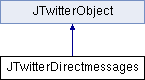
 Graphe d'héritage de JTwitterDirectmessages: